
The Prince William County Circuit Court
Prince William County sits in Virginia's 31st Judicial Circuit and 31st Judicial District. The Circuit Court is the county's trial court of general jurisdiction. That means it can hear nearly any kind of case the law allows. It tries felonies. It hears big civil suits. It handles divorce, chancery, and the probate of wills through the Clerk. No other court in the county has this reach.
The court also serves more than the county alone. The Clerk's Office covers Prince William County plus the Cities of Manassas and Manassas Park. So a single circuit serves three places at once. The bench is large for a busy region. Circuit judges include the Hon. Angela Lemmon Horan, the Hon. Lisa Michelle Baird, the Hon. Robert P. Coleman, the Hon. Kimberly A. Irving, the Hon. William E. Jarvis, the Hon. Petula C. Metzler, and the Hon. Carroll A. Weimer Jr. The Clerk of Circuit Court is Jacqueline C. Smith, a constitutional officer.
Circuit case numbers start with the letter C. The county tells searchers to read that first letter as a clue. A C means the file lives with the Circuit Court. If you need to look up a full case file, the Prince William County court records page walks through the steps.
Courts at the Prince William County Judicial Center
Four court bodies work out of the same complex in Manassas. The Circuit Court leads, and three lower courts handle the day-to-day volume of traffic, family, and minor crime. Each has its own clerk, phone lines, and floor. The table lists the role, address, and main phone for each one.
| Court | Role / Jurisdiction | Address | Phone |
|---|---|---|---|
| Prince William Circuit Court (31st Judicial Circuit) | Felonies, major civil, divorce, chancery, appeals from district courts, probate through the Clerk, records | 9311 Lee Avenue, Third Floor, Manassas, VA 20110 | Main (703) 792-6015; Civil (703) 792-6029; Criminal (703) 792-6031 |
| Prince William General District Court (31st Judicial District) | Misdemeanors, traffic infractions, preliminary felony hearings, civil up to $25,000, small claims, landlord-tenant | 9311 Lee Avenue, Manassas, VA 20110 | Traffic/Criminal (703) 792-6141; Civil (703) 792-6149 |
| Juvenile and Domestic Relations District Court | Delinquency, abuse and neglect, custody, visitation, support, family-abuse protective orders | 9311 Lee Avenue, Manassas, VA 20110 | (703) 792-6160 |
| Magistrate Services | First appearances, warrants, bail and conditions of release | Judicial Center area, Manassas | Part of the Virginia magistrate system |
All four share the building, but they do not share files. The Circuit Court Clerk cannot help with a General District or JDR matter. Call the right division first. The county's "Which Court?" guidance is the fastest way to confirm where a case belongs.
Note: Case numbers tell you the court at a glance: C for Circuit, G for General District, and J for the Juvenile and Domestic Relations District Court.
What the Prince William County Circuit Court Handles
The Circuit Court's reach is broad. On the criminal side, it tries all felony offenses that can send a person to the state penitentiary. It also hears misdemeanors that come from a grand jury indictment, plus juvenile felony cases that get certified up from the lower court. Felony jury trials happen here. The General District Court holds no jury trials, so serious cases move to this court for a full trial.
On the civil side, the dollar amount sets the line. Claims over $25,000 belong only to the Circuit Court. Claims between $4,500 and $25,000 can be filed in either the Circuit Court or the General District Court. The court also rules on the validity of local ordinances and bylaws. Family law runs through here too. Divorce, annulment, and chancery suits are Circuit Court matters.
Probate is a special case. The Clerk of Circuit Court, not a judge, handles the probate of wills and the start of most estates. That work, along with deeds and marriage licenses, sits in the Clerk's Office on the third floor. The Clerk of Circuit Court page covers those duties and the fees that go with them.
- Felony trials, including jury trials, under state law.
- Civil suits over $25,000, with no upper cap.
- Divorce, annulment, and other chancery matters.
- Probate of wills and estate administration through the Clerk.
- Appeals from the district courts, heard fresh.
The General District Court Supporting the Circuit Court
The General District Court is the high-volume court in the 31st Judicial District. It is on the second floor. Most people who deal with a court touch this one first. It handles misdemeanors under state law and local rules. It hears traffic infractions. It runs preliminary hearings in felony cases, where a judge decides if there is enough proof to send the matter up to the Circuit Court. There are no jury trials at this level.
Its civil side is busy as well. The court hears civil claims up to $25,000. Claims under $4,500 can be started only here. A small claims division takes cases up to $5,000, where parties speak for themselves without a lawyer. Landlord-tenant disputes also land in this court. The clerk for the General District Court is Keshara J. Luster.
The county posts contact details and division phone numbers for the General District Court.
You can review the court's contact information page for the Prince William General District Court.
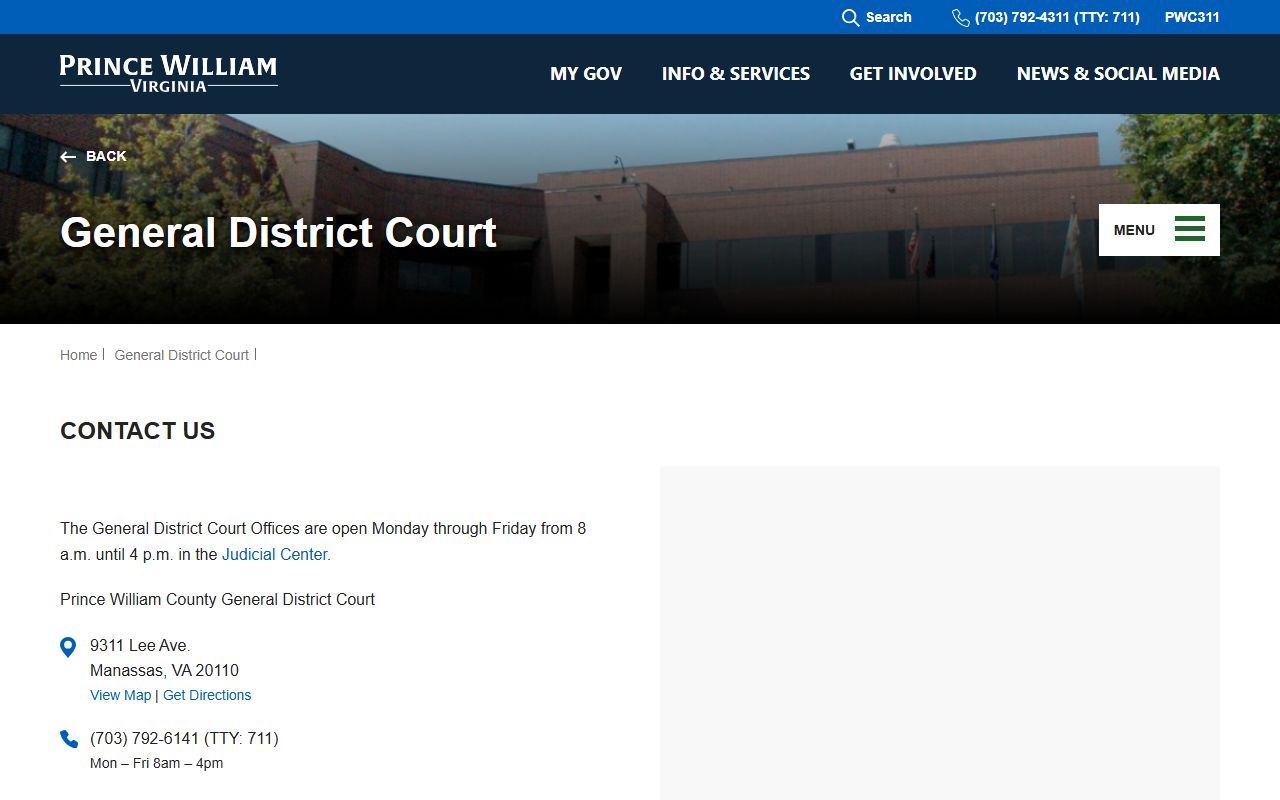
The page splits out the traffic and criminal line from the civil line, so you reach the right clerk faster. Case numbers here start with G.
State Listing for the Prince William County Courts
The Virginia Judiciary keeps its own page for each district court. The state listing for Prince William General District Court repeats the address, hours, and phone lines, and links to the statewide case search. It is a good cross-check against the county page. The two sources should match.
The Virginia courts site hosts the official record.
Open the Virginia Judiciary listing for the Prince William General District Court.
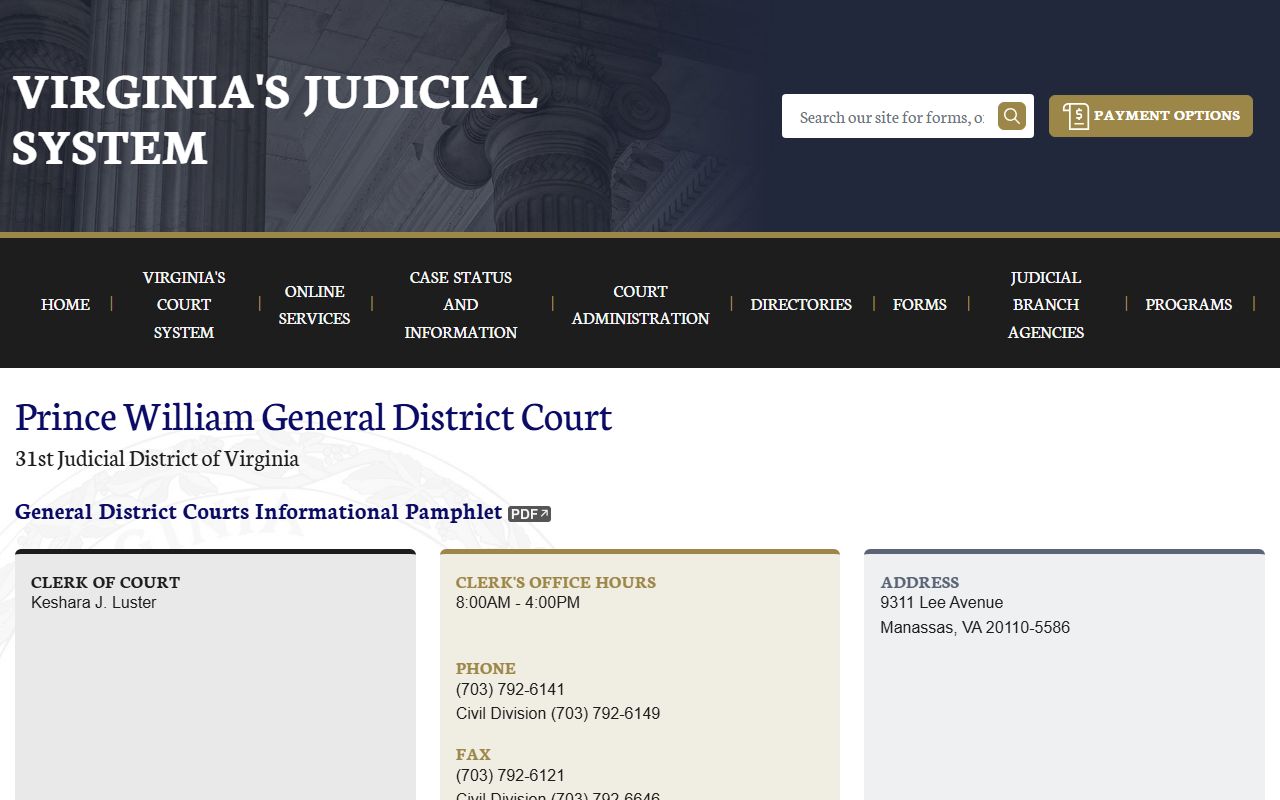
From there you can jump to the statewide tools that show district criminal and traffic cases. To search those files directly, see the Prince William County court records page for the case portals.
Juvenile and Domestic Relations District Court
The JDR court works on the first floor. It deals with the most personal matters in the system. It hears juvenile delinquency and status offenses. It handles abuse and neglect cases. It decides custody, visitation, and support. It issues family-abuse protective orders. Many of its files are confidential by law, so the public cannot view them the way it views a Circuit Court file.
The court covers a wide list of family and household issues. Spousal support, child support, abandonment, and foster care all run through this court. Some offenses between family or household members start here too. The clerk for the JDR court is Monica Burnett. Case numbers begin with J.
The county lists contact details for the JDR court online.
See the JDR contact page for the Prince William Juvenile and Domestic Relations Court.
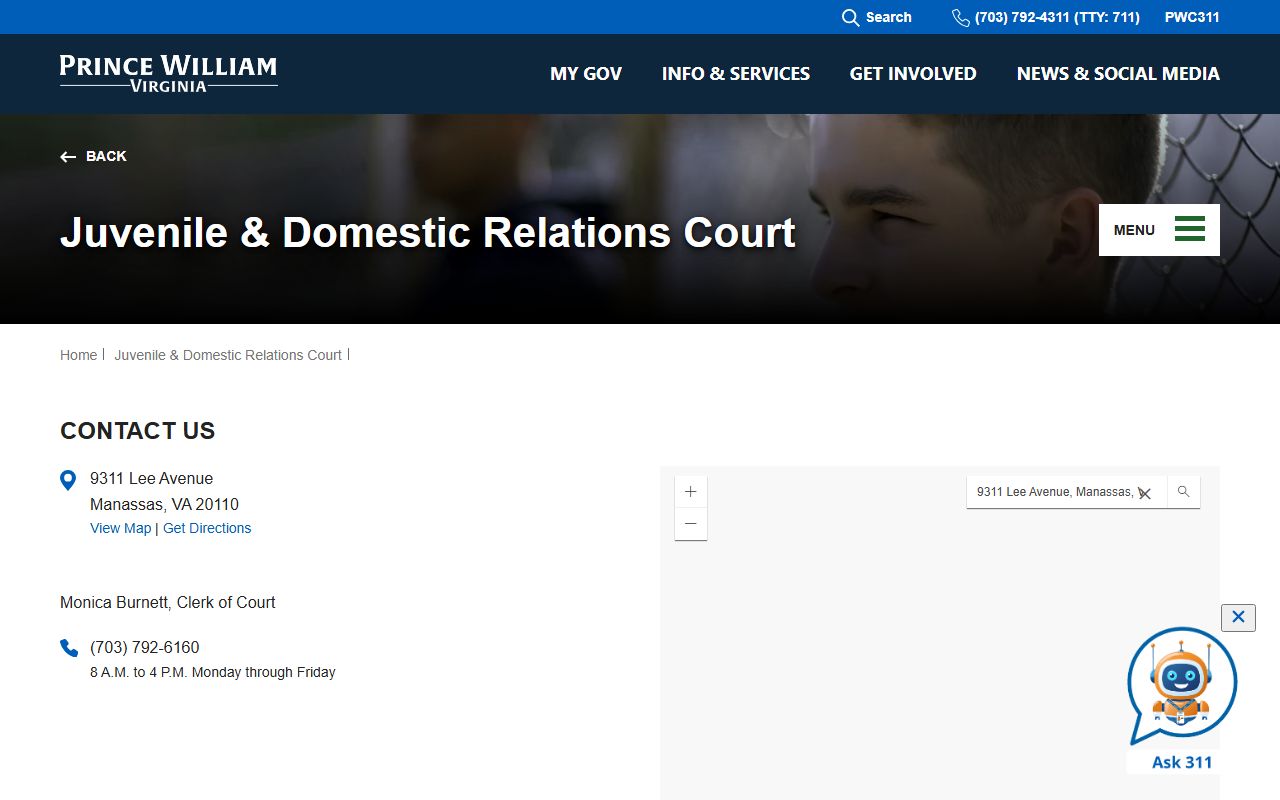
Because so many JDR files are sealed, plan to call ahead before any trip. A clerk can tell you what is open and what is closed.
Note: JDR files such as delinquency and abuse cases are often confidential, so a public records search will not show their detail.
Magistrate Services in the Prince William County Court System
Magistrates work behind the scenes, but they touch many cases first. A magistrate is the first judicial officer many people meet after an arrest. Magistrates hold first appearances. They issue warrants and summonses. They set bail and the conditions of release. They operate around the clock as part of the statewide Virginia magistrate system.
A magistrate does not try cases. The job is to make early, fast calls that move a case into the proper court. After a magistrate acts, the file heads to the General District Court or the Circuit Court, depending on the charge. To follow what a magistrate set in motion, the Prince William County warrant records page covers warrants and how to check them.
Circuit Court vs General District Court vs JDR
The three trial courts each own a slice of the work. The split comes down to case type, dollar limits, jury rights, and how an appeal moves. The table sets them side by side so the differences are clear.
| Feature | Circuit Court | General District Court | JDR District Court |
|---|---|---|---|
| Case types | Felonies, major civil, divorce, chancery, probate | Misdemeanors, traffic, small civil, landlord-tenant | Delinquency, custody, support, protective orders |
| Dollar limits | Civil over $25,000, no cap | Civil up to $25,000; small claims up to $5,000 | Support and family matters, not dollar-based |
| Jury trials | Yes | No | No |
| Appeals | To the Court of Appeals of Virginia | To the Circuit Court, heard de novo | To the Circuit Court, heard de novo |
One word in that table matters a lot. De novo means a fresh start. When you appeal a General District or JDR ruling to the Circuit Court, the new trial begins as if the first never happened. No part of the old record binds the higher court.
How a Case Moves Through the Court System
A case rarely stays in one court. It climbs a ladder, and each rung has a different job. A minor charge may end at the first level. A serious one can travel all the way to the top state court. The flow below shows the common path for a Prince William County case.
General District Court › Circuit Court › Court of Appeals of Virginia › Supreme Court of Virginia
- A misdemeanor or traffic case opens in the General District Court, or a family case opens in the JDR court.
- A felony starts with a preliminary hearing in the General District Court, then moves up to the Circuit Court for trial.
- A losing party at the district level may appeal to the Circuit Court, where the case is tried again de novo.
- A Circuit Court ruling may be appealed to the Court of Appeals of Virginia.
- From there, a case may seek review by the Supreme Court of Virginia, the state's highest court.
Not every case takes every step. Most stop early. But the path shows why the Circuit Court sits at the center: it is both a trial court and the place where district appeals land. To track hearing dates as a case moves, the Prince William County court dockets page lists how dockets work.
Prince William County Court Building and Hours
All three trial courts share one address. The Prince William County Judicial Center stands at 9311 Lee Avenue in Manassas. The layout is simple. The JDR court is on the first floor. The General District Court is on the second. The Circuit Court and its Clerk's Office are on the third. The Adult Detention Center sits next door at 9320 Lee Avenue.
Hours differ a little by court. The Circuit Court Clerk's Office runs 8:30 a.m. to 5:00 p.m., with no payments taken after 4:30 p.m. The General District Court and the JDR court open 8:00 a.m. to 4:00 p.m. Bring a case number if you have one. Arrive early to clear security screening, since the courthouse screens everyone who enters.
Prince William County Judicial Center
9311 Lee Avenue
Manassas, VA 20110
Circuit (703) 792-6015
Circuit Clerk: Mon-Fri 8:30 a.m. to 5:00 p.m.
District courts: Mon-Fri 8:00 a.m. to 4:00 p.m.
Public parking lots ring the courthouse, but rates and rules can change, so confirm them before you arrive. To find a hearing room on a busy docket day, watch the digital boards in the lobby.