
Is There a Prince William County Warrant Search Portal?
The short answer is no. No official public Prince William County active-warrant search portal was found. The county does not post a live list of open warrants for anyone to browse. This is normal across Virginia. An active warrant is law-enforcement data, and police do not publish it for the world to read. So you cannot just type a name into a county page and see who has a warrant out.
That gap leads a lot of people to so-called warrant lookup sites. Skip them. These data-broker pages are not official. They pull old or wrong records, charge fees, and answer to no court. A name match on one of those sites proves nothing. The only trustworthy answer comes from a court, a law-enforcement agency, or a licensed attorney.
Some warrant detail does become public. Once a case is filed and a hearing is set, the matter can appear in the state court systems. A capias or bench warrant noted in a case file is one example. But an active, unserved warrant that no one has acted on yet will not show there. Keep that line in mind during any Prince William County warrant search.
Do not rely on unofficial warrant websites. Third-party "warrant lookup" pages are not tied to any court or police agency. Their data is often stale or flat wrong. Verify through an official source every time.
How Prince William County Warrants Appear in Court Systems
Warrants are not free-floating. Each one ties to a charge or a case. When that case becomes public, parts of the warrant story can show up in the Virginia court systems. The case event might read as a capias, a bench warrant, or a failure-to-appear note. So you do not search for the warrant by itself. You search for the case, then read the events on it.
Two main court tracks hold this kind of data. Misdemeanors, traffic charges, and failure-to-appear matters sit in the General District Court. Felony cases and many capias entries sit in the Circuit Court. The court level decides which system to check and which clerk to call. A name search in the right system is the closest thing to a public warrant search in Prince William County.
Custody status is a separate question. A court file may show a hearing or a disposition, yet not reflect whether a person is in jail right now. Online court data can lag the real-time picture. To learn custody status, you confirm with the court or the Adult Detention Center, not the case events alone.
For the case-search steps themselves, the Prince William County court records page lays out how to use both the Circuit and General District tools.
Types of Warrants and Capiases in Prince William County
Not all warrants mean the same thing. The word covers a few orders that send police to find a person. Knowing the type helps you ask the right office the right question. It also shapes what you do next. Here are the common kinds tied to local court cases.
- Arrest warrant - an order to arrest a person on a specific charge.
- Bench warrant - issued by a judge, often when someone misses a scheduled court date.
- Capias - a court order that commands an arrest or an appearance; common after a failure to appear or to enforce a court order.
- Failure-to-appear order - tied to a missed hearing and a frequent root of a bench warrant or capias.
A capias and a bench warrant often look alike to the public. Both can lead to an arrest. Both can be recalled by the court in some cases. The label on the case event tells the clerk how to read the file. If you see one of these terms on a record, that is your cue to call the court that issued it.
Sealed and juvenile warrants are a different matter. They are not public. A juvenile case is restricted under Virginia Code § 16.1-305, and only parties or authorized agencies may view it. So a warrant tied to a juvenile case will not surface in a public search, and the clerk cannot share it.
Prince William County Warrant Search Fields
Because there is no warrant-only portal, the fields below describe how warrant data is found indirectly through the public court systems. None of these is a true active-warrant field. Each one is a way to locate a case that may carry a warrant or capias entry. The table sums up what you can and cannot search.
| Field Label | Type | Required | Options / Format Notes |
|---|---|---|---|
| Active warrant portal | n/a | n/a | No official public active warrant portal located. |
| Case number | court search | optional | May locate warrant/capias history if case is public. |
| Name | court search | optional | Search court systems by name. |
| Hearing date | court search | optional | Useful for failure-to-appear context. |
| Charge/case type | result field | n/a | May show offense, hearing, disposition. |
| Bond/release | court/ADC inquiry | n/a | Confirm with court/ADC; online court data may lag custody status. |
Notice the top row. The portal itself does not exist for the public. The rest of the rows lean on case search, which means a warrant only appears if its underlying case is already open to view. That is the core limit of any Prince William County warrant search.
Note: A blank or missing result does not mean a person is clear, since an active warrant may simply not be public yet, so confirm with the court.
What a Prince William County Warrant Record Shows
When warrant data does surface inside a public case, it comes with a few standard fields. These mirror the fields on any court case. They do not show police-only detail or the physical warrant document. The list below covers what you can expect to read off a public case that carries a warrant or capias entry.
- Case number
- The court and case ID; may link to a warrant or capias history if the case is public.
- Name
- The party named in the case; how you search the court systems.
- Hearing date
- The next or past court date; useful for failure-to-appear context.
- Charge or case type
- The offense or claim, which may show the hearing and disposition.
- Bond or release
- Confirmed with the court or the ADC, since online court data may lag custody status.
That is the full picture the public side gives you. There is no field for an active yes-or-no warrant flag. If you need a clear answer on whether a warrant is open, you take it to a live person at the court or to a lawyer. The fields above point you to the case; they do not certify a warrant's status.
Magistrate First Appearance and Bail in Prince William County
An arrest sets off a fixed process. The intake section at the Adult Detention Center receives every person brought in. From there, the case moves to the magistrate. The Magistrate Court holds a first appearance hearing to tell the arrested person what the charges are. This step happens early, often within hours of booking.
At first appearance, the judge or magistrate looks at bail. They weigh whether to release the person and on what terms. The outcome shapes the next steps. Some people are released on a promise to return. Others are held or given a bond amount. The decision turns on the charge, the person's record, and the risk of flight.
After the magistrate, the case flows into the right court system. Local case data then appears through the General District, JDR, or Circuit systems, depending on the charge type and the stage of the case. So a person picked up on a warrant moves from intake, to the magistrate, to a court file you may later be able to view. For booking and custody questions, see the Prince William County inmate records page.
Important: Bond and surrender terms are legal matters. Before anyone turns themselves in on a warrant, a defense attorney can advise on bond and a safe surrender so the person is not held longer than needed.
Where to Verify a Prince William County Warrant Safely
The safe path is direct. You call the office that would hold the case. Which office depends on the charge. Misdemeanor, traffic, and failure-to-appear matters go to the General District Court. Felony and capias matters go to the Circuit Court Criminal Clerk. Civil process and court security questions go to the Sheriff's Office. A defense attorney can check any of these and advise you.
Use the contacts below to reach the right office. Have a name and, if you can, a case number ready. The clerks deal with public case data, not police-only warrant lists, so they answer within those limits. Even so, this is the trustworthy route.
General District Court
Misdemeanor, traffic, failure-to-appear
(703) 792-6141
Circuit Court Criminal Clerk
Felony and capias records
(703) 792-6031
The Sheriff's Office handles civil process and court security in the county. It is the right place for questions on serving papers and on security at the Judicial Center.
The county's Sheriff's Office page lists the office's duties and contact options.
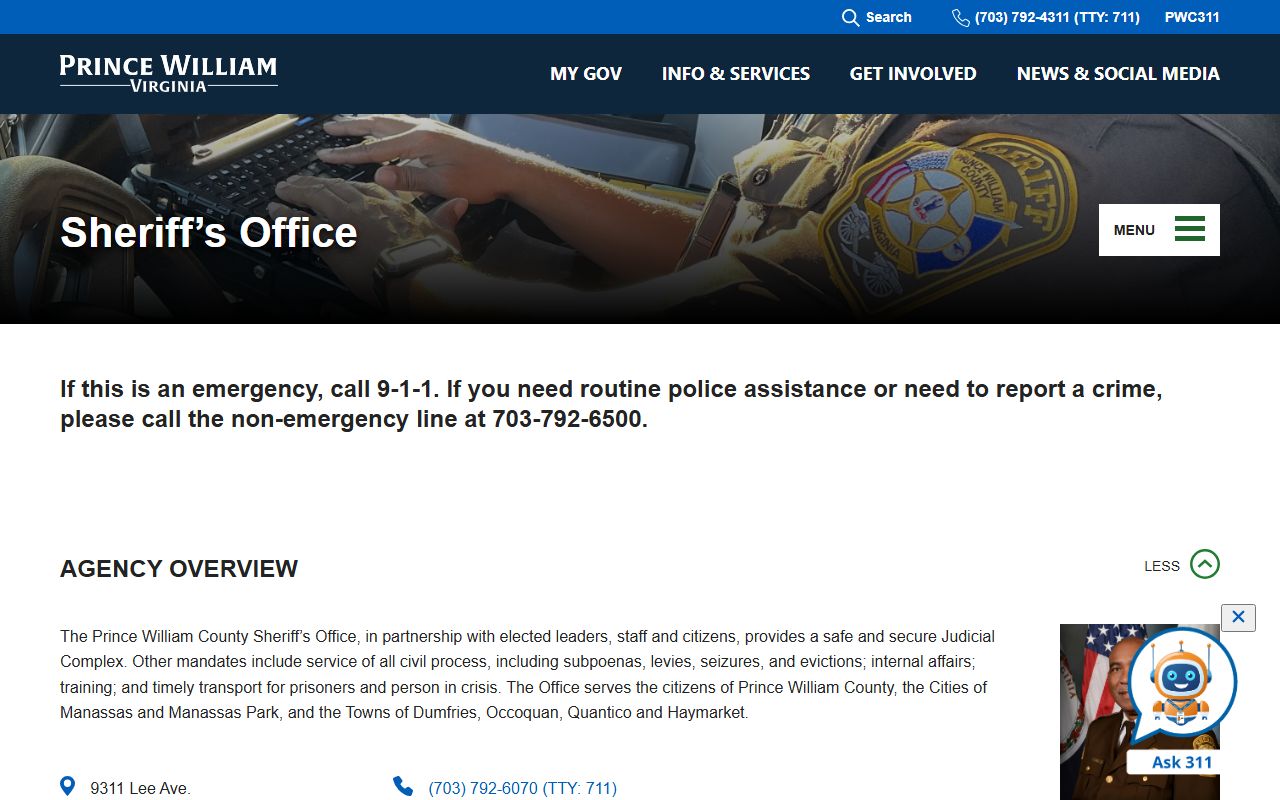
The page is a good first stop for civil process and court-security questions, though the courts handle case records and the police handle law-enforcement matters.
How to Resolve an Outstanding Prince William County Warrant
Finding out a warrant may be open is stressful. The smart move is to act through official channels, not to guess from a search site. The steps below follow the order most people take when a warrant is tied to a court case. Take them one at a time, and lean on a lawyer for the parts that touch bond or arrest.
- Verify the warrant through an official court, a law-enforcement agency, or an attorney. Confirm it is real before you act.
- Do not rely on unofficial warrant websites. Their data is not official and can mislead you.
- If it is tied to a missed court date, ask the court about the next hearing, the capias or bench-warrant status, and whether a motion to recall or a new court date is possible.
- If arrest or surrender is required, ask an attorney about bond and a safe surrender so the process goes smoothly.
- After it is resolved, check the court system later to confirm the disposition or update. Remember that systems may not update right away.
The last step trips people up. A warrant can be cleared in court while the online record still shows the old status for a while. That lag is normal. Give the system time, then check again. If the record still looks wrong after a fair wait, call the clerk who handled the case.
Note: The clerk's staff cannot give legal advice or tell you if a charge can be cleared, so route eligibility questions to an attorney.
Sealed Warrants and Expungement in Prince William County
Some warrant records never reach the public. Juvenile warrants and sealed-case warrants stay closed. A sealed case shows only an index online, and a party must come to the Clerk's Office for access. Juvenile matters are restricted under Virginia Code § 16.1-305. So a search of these will come back empty even though a record exists.
If a charge tied to a warrant ended without a conviction, the record may qualify for expungement. Eligible outcomes include an acquittal, a dismissal, nolle prosequi, an absolute pardon, or an arrest made under the wrong name. The person files a petition with the Circuit Court. An expunged record is pulled from public view, then destroyed three years after the order is entered.
The legal basis for this sits in state code. You can read the statute that governs the process and the eligible outcomes before you decide whether to file.
Virginia Code § 19.2-392.2 sets out who may petition to expunge police and court records and how it works.
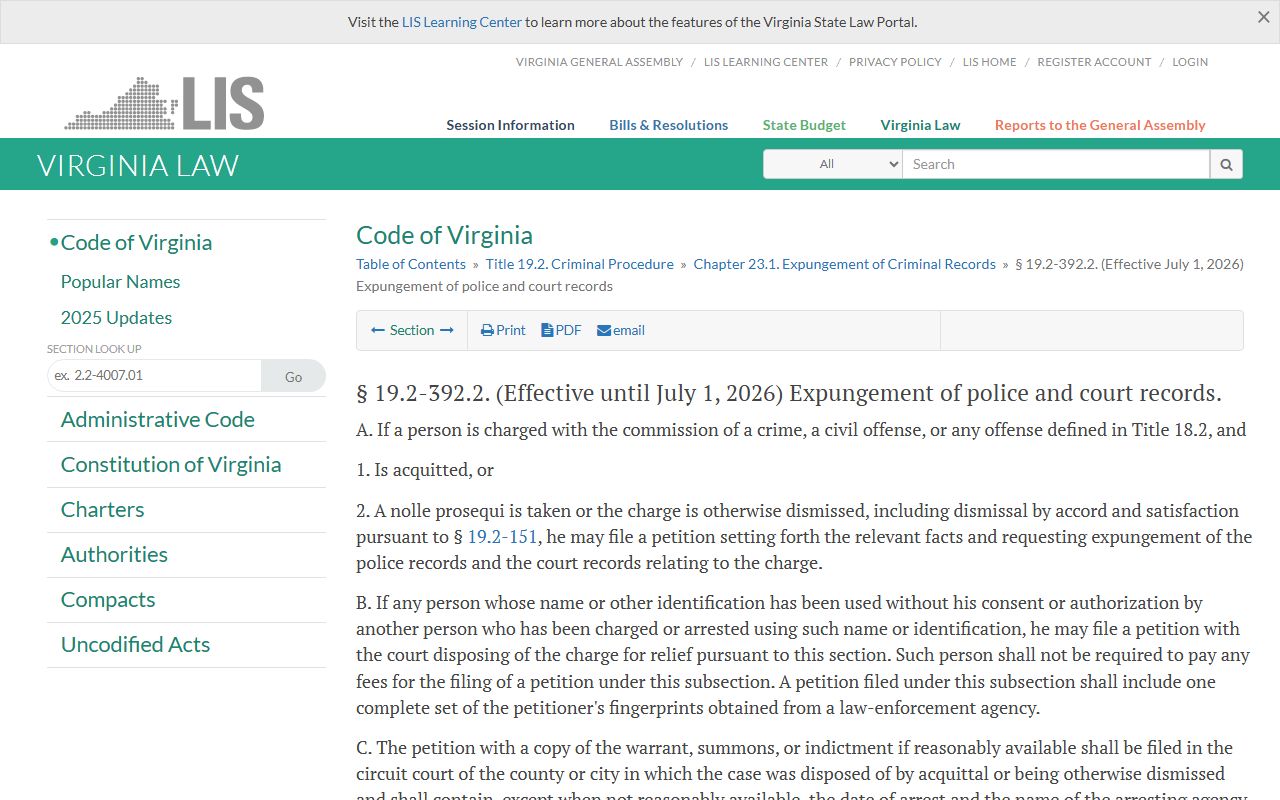
The statute spells out the eligible outcomes and the petition route, though the Clerk cannot advise on whether your charge qualifies. For the full local filing steps and forms, the Prince William County arrest records page covers expungement in detail.