
How to Find Recent Arrests in Prince William County
Recent arrests in Prince William County run through one jail. The Prince William-Manassas Regional Adult Detention Center books and holds people for the county, the Cities of Manassas and Manassas Park, and the towns of Dumfries, Haymarket, Occoquan, Quantico, and Triangle. After an arrest, the intake section receives the person and starts the standard booking process. That step records the charge, takes prints, and logs the custody.
There is a catch. No official public online jail roster or arrest blotter was found on the county pages. The Detention Center does not post a searchable mugshot portal or a daily arrest log that the public can open. So a name-by-name online lookup is not available the way it is in some states.
Custody is verified by phone instead. Call the Detention Center at (703) 792-6420 to confirm whether someone is held, the charge, and the bond status. TTY users can dial 711. The facility sits at 9320 Lee Avenue in Manassas, and staff handle intake around the clock.
Prince William-Manassas Adult Detention Center
9320 Lee Avenue
Manassas, VA 20110
(703) 792-6420 (TTY: 711)
adc@pwcgov.org
For more on custody lookups, contact methods, and what the jail can confirm, see the Prince William County inmate records page. It covers how to reach an inmate, how to check a hold, and where state prison custody is searched.
Note: Because the county posts no public arrest blotter, a phone call to the Detention Center is the most direct way to verify a recent booking.
What Happens After an Arrest in Prince William County
The path after an arrest is short at the start. A person is taken into custody, brought to the Detention Center, and booked. Booking logs the charge, runs prints, and opens a custody file. Then a magistrate steps in.
The Magistrate's Office holds a first appearance soon after intake. At that hearing the magistrate reads the charges and tells the person why they are held. The magistrate also weighs bail and sets the terms of release. Some people are released on a written promise to appear. Others post a bond or stay in custody until a judge reviews the case.
What comes next depends on the charge. A felony usually moves toward the Circuit Court. A misdemeanor or traffic charge stays in the General District Court. Family or juvenile matters route to the Juvenile and Domestic Relations District Court. Court files do not always update the same day, so an arrest can show in jail records before a case number appears in a court system.
Arrest Record vs Criminal Court Record
An arrest record and a criminal court record are not the same thing. They start at different offices and hold different facts. One is made at the moment of the arrest. The other is built as the case moves through court. Knowing the split saves time when you search.
The arrest record is the booking. It is created by the police or the jail when a person is taken in. The court record is the case file. It is kept by the Clerk in the Circuit Court or the General District Court and grows with each hearing and order.
| Arrest Record | Criminal Court Record |
|---|---|
| Made by police or the jail at booking | Made by the court Clerk as a case file |
| Held at the Adult Detention Center | Held in Circuit or General District Court |
| Shows charge, custody, and bond status | Shows parties, hearings, and disposition |
| Verified by phone with the jail | Searched online through state case systems |
| Reflects the start of the matter | Reflects how the matter is resolved |
An arrest does not prove guilt. It only marks that a charge was filed and a person was held. The court record is where you learn the outcome. For the full case history, the booking is just the first page.
Charges vs Convictions in Prince William County Criminal Records
A charge is an accusation. A conviction is a finding of guilt. The gap between the two is wide, and reading a record the wrong way can lead to a false picture of someone's history. Many charges never end in a conviction.
A charge appears at arrest and again when the case opens in court. It can be dropped, reduced, or beaten at trial. A conviction comes only after a guilty plea or a guilty verdict. Until then, the law treats the person as not guilty.
| Charge | Conviction |
|---|---|
| An accusation that a crime was committed | A formal finding or admission of guilt |
| Filed at arrest or by indictment | Entered after a plea or a verdict |
| May be dropped, reduced, or dismissed | Carries a sentence set by the judge |
| Does not show the case outcome | Is the recorded outcome of the case |
The disposition field in a court record tells you which one applies. It might read guilty, not guilty, dismissed, or nolle prosequi, which means the prosecutor chose not to go forward. Mugshots tie to this same point. A booking photo is taken at arrest, not at conviction, so a photo alone proves nothing about the result of a case. The county posts no public mugshot gallery, and a mugshot is not part of the public court file you pull online.
Note: A charge listed in a record may have ended in a dismissal or acquittal, so always check the disposition before drawing any conclusion.
Where Prince William County Criminal Cases Live
Once a charge reaches court, the case file is searchable online. The court that holds it depends on the level of the charge. Felonies are tried in the Circuit Court. Misdemeanors and traffic offenses are handled by the General District Court. Each court runs its own free case system.
Circuit Court cases are found through the Circuit Court Case Information system. You pick Prince William County Circuit, choose the criminal division, and search by name, case number, or hearing date. District cases use the General District Court Case Information system, which is where most misdemeanor and traffic files sit.
This page keeps the case search short on purpose. For the step-by-step walkthrough, the search field tables, and what each result returns, use the Prince William County court records page. It covers the Circuit and District tools in full. A DUI or DWI charge is criminal and can show in both jail and court records, so the traffic court records page covers how those cases cross over.
If you are tracing a case from an active warrant rather than a booking, the warrant records page explains how warrants are issued and searched in the county.
Background Checks and Prince William County Criminal Records
People often assume the courthouse runs background checks. It does not. The Circuit Court Clerk states plainly that the office does not perform criminal records checks. A case search shows one court at a time, not a full statewide history.
The county's notice on this point is worth a look before you make a trip. It explains what the Clerk can and cannot do for a records request.
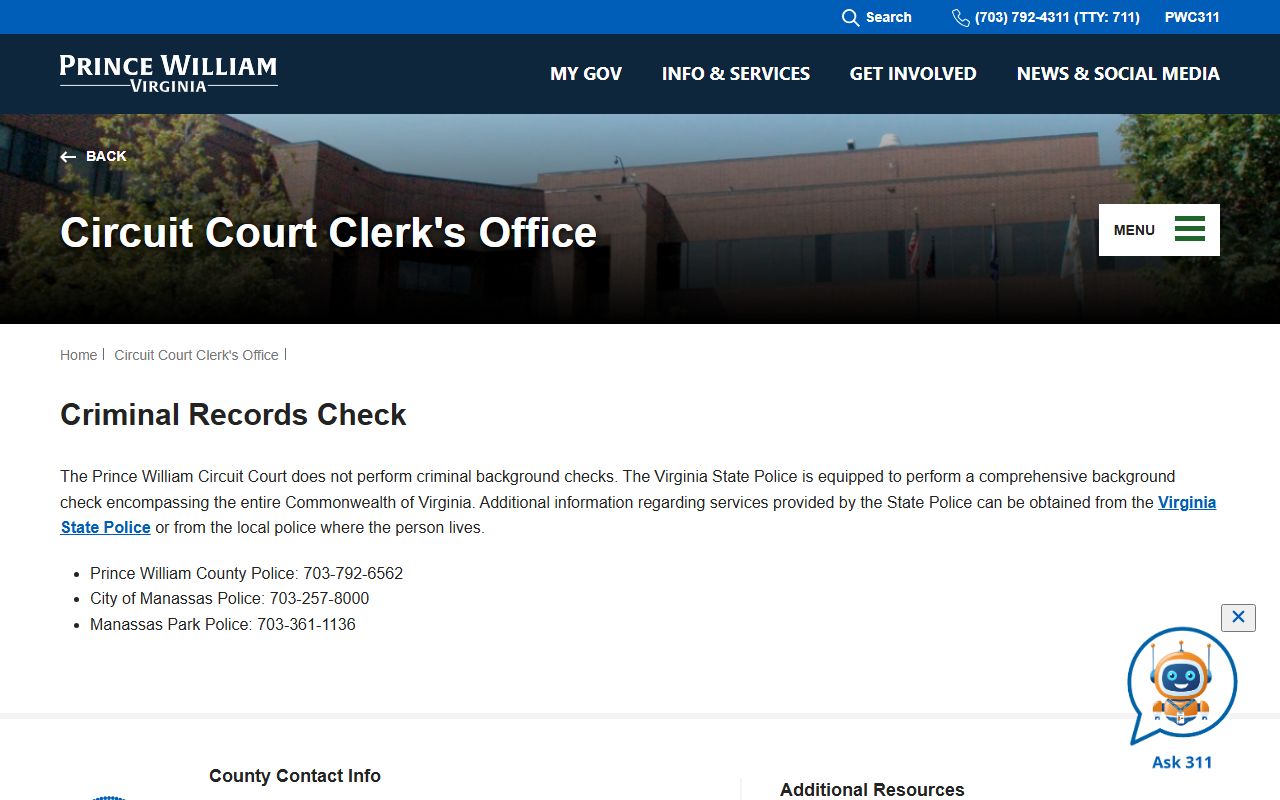
The notice points people to the right office for an official history instead of the court Clerk.
Official criminal history checks go through the Virginia State Police. The State Police run the Central Criminal Records Exchange and handle name-based and fingerprint-based checks for employers, agencies, and individuals. Their service page lists the forms, fees, and the request steps.
The State Police background page is the starting point for any official record check.
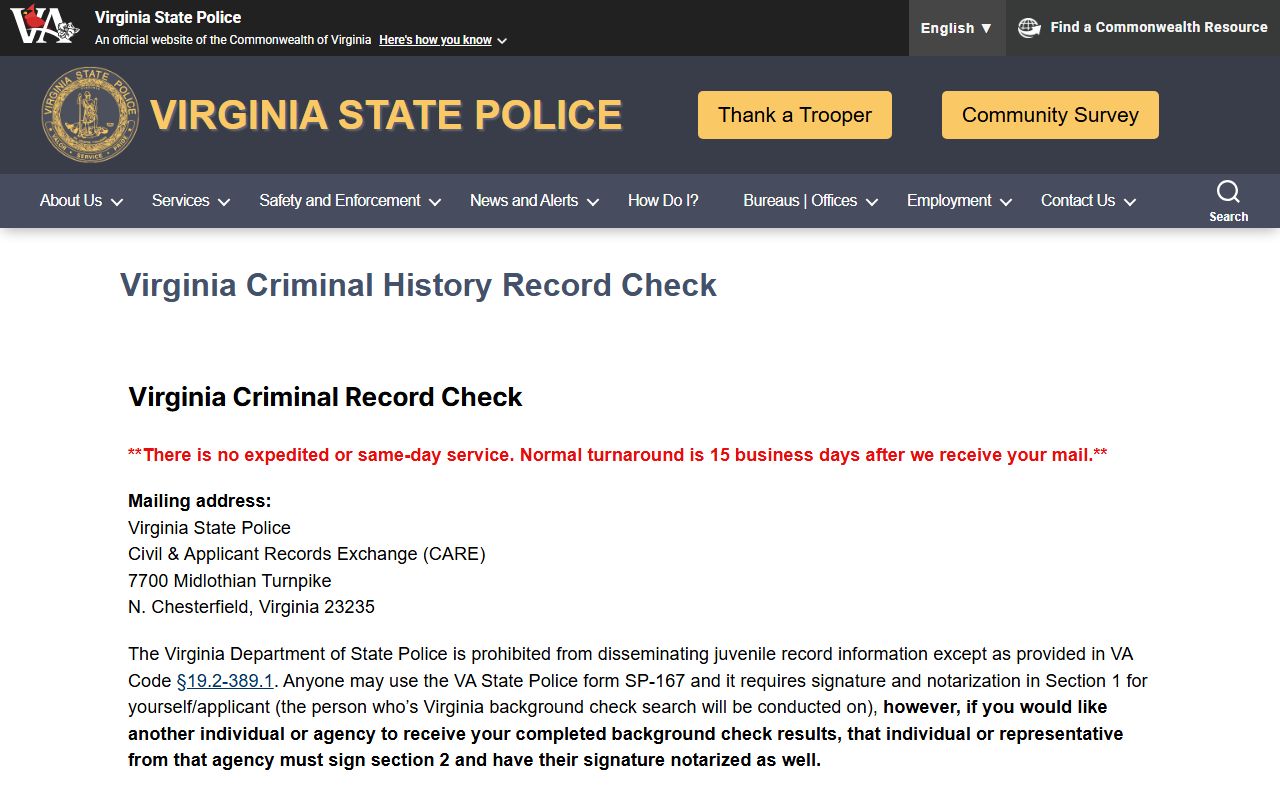
The page lays out how to request a statewide criminal history and who may receive one. Visit the Virginia State Police criminal background service for the current process.
Who may get that history is set by law. Virginia Code § 19.2-389 controls the dissemination of criminal history record information. It limits who can receive an official record and for what purpose. The statute text spells out the approved recipients.
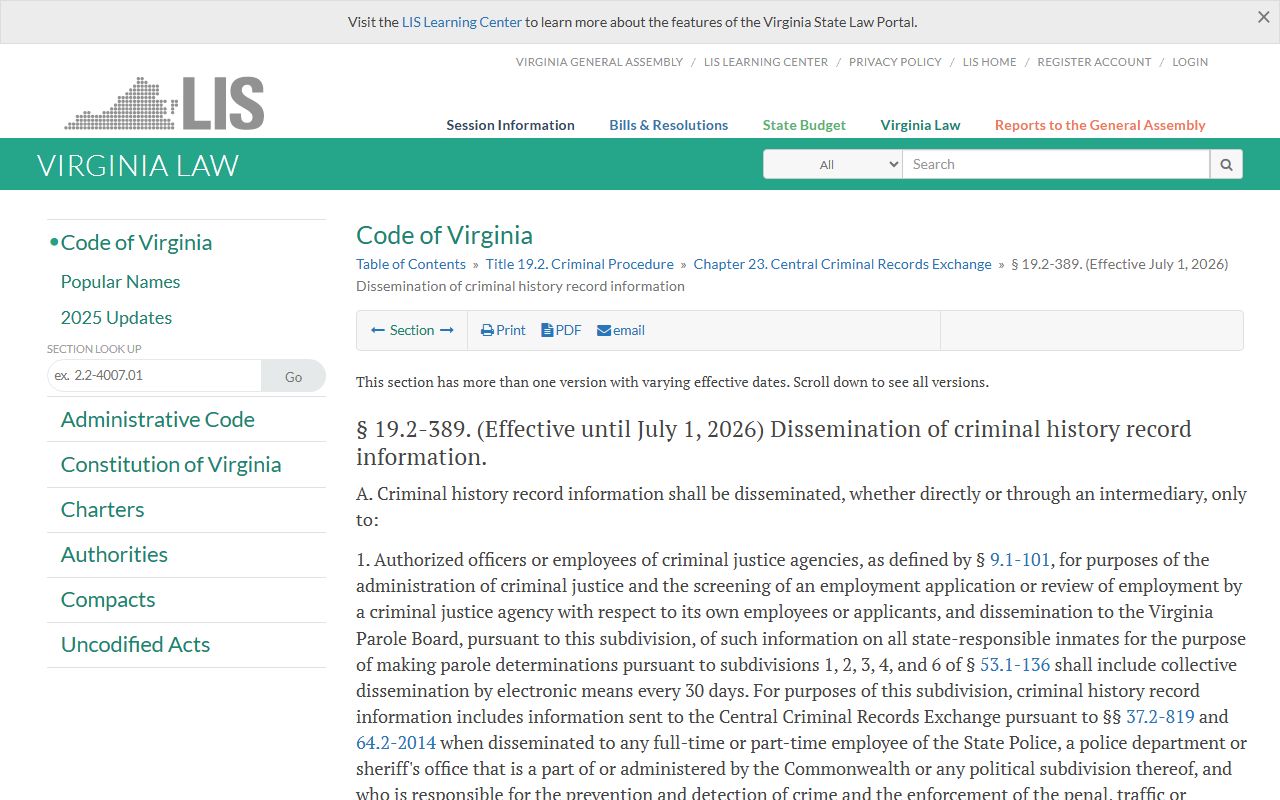
Reading the statute helps explain why a court case search and an official background check return different results. The Circuit Court criminal records check page confirms the Clerk routes these requests to the State Police.
Records That Are Restricted or Confidential
Not every criminal record is open. Some are closed by statute. Others are hidden by a court order. Juvenile cases are restricted under Virginia Code § 16.1-305 and can be viewed only by parties or authorized agencies. Juvenile record dissemination is further limited by § 19.2-389.1.
A few categories sit outside public view for set reasons. The most common ones are listed here.
- Juvenile delinquency, abuse, and CHINS cases under § 16.1-305.
- Adoption files, open only to parties through the Clerk.
- Sealed cases, where only the index shows online.
- Expunged records, removed from public access by court order.
- Personal identifiers such as social security and account numbers, which are redacted.
Sealed and expunged are not the same idea, and people mix them up often. The next section breaks down the difference and walks through how an expungement is filed in the county.
Sealed vs Expunged Prince William County Arrest Records
Both terms mean a record is pulled from public view. The difference is in how far the removal goes and what triggers it. A sealed record still exists and can be reached by certain parties. An expunged record is set on a path to be destroyed.
In Prince William County, a sealed case shows only its index online, and a party must come to the Clerk's Office to view the full file. An expungement is a court process that clears an eligible charge. After the order, the record is removed from public access, then destroyed three years later.
| Sealed Record | Expunged Record |
|---|---|
| Hidden from public view but still kept | Removed from public access by court order |
| Index may still appear online | Destroyed three years after the order |
| Parties can view it through the Clerk | Reserved for eligible case outcomes |
| Set by statute or a court order | Filed by petition in the Circuit Court |
Only certain outcomes qualify for an expungement. Virginia Code § 19.2-392.2 lists them: an acquittal, a nolle prosequi, a dismissal, an absolute pardon, an arrest of the wrong person, or a case where someone used your identity without consent. A conviction does not qualify under this section.
How to Expunge a Prince William County Arrest Record
The county posts a procedural guide for expungement, and it warns that the steps are not legal advice. The Clerk cannot tell you whether you are eligible. That call rests with you and, if needed, an attorney. The process runs through the Circuit Court and follows a set order.
The local guide shows the forms, the copies needed, and the fee. It is the best source before you file.
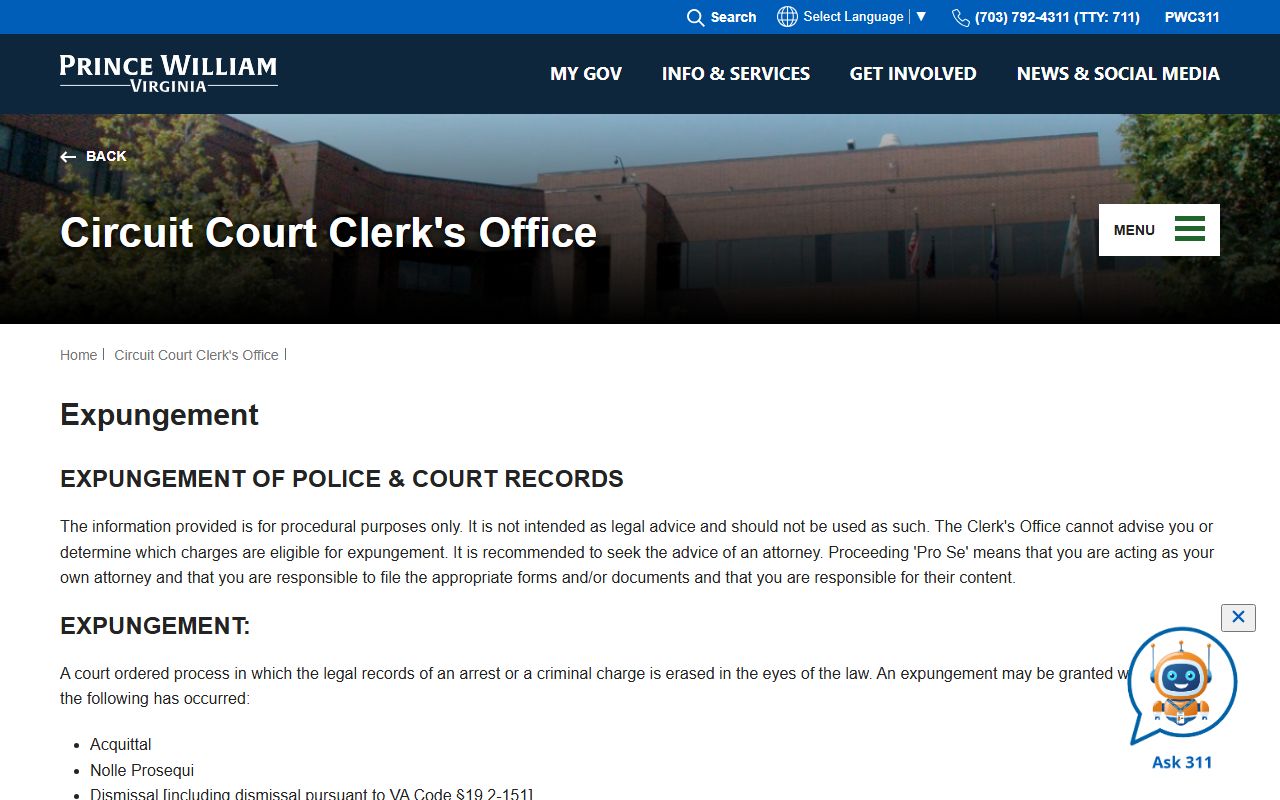
The page maps each step so the petition is complete when it reaches the court. Start at the county's Circuit Court expungement page.
- Confirm the case outcome is eligible under § 19.2-392.2, such as an acquittal, nolle prosequi, dismissal, absolute pardon, or wrong-person arrest.
- Get four copies of the charges or warrant and the disposition from the court that heard the case.
- File the Petition for Expungement, Form CC-1473, and the Expungement Order, Form CC-1474, with the Circuit Court, along with the warrant and disposition.
- Pay the $98 filing fee, which is $86 for filing plus $12 for service on the Commonwealth.
- Take a copy of the petition bearing the case number for fingerprinting, then mail the fingerprint cards to the Virginia State Police.
- Wait for the State Police report and the Commonwealth's answer to reach the court.
- File notice for the 9:00 a.m. Friday Motions Day docket so a judge can rule.
If the judge grants the petition, the $86 filing fee is returned. The record is then removed from public access and destroyed three years after the order. An expungement based on an absolute pardon carries no filing fee and does not require fingerprints. Keep your own copy of every document you file.
Note: The Clerk cannot advise you on eligibility, so review the statute and the county guide closely or speak with an attorney before filing.
Prosecution and Defense in Prince William County Criminal Cases
Two sides shape every criminal case once it reaches court. One prosecutes. The other defends. Knowing which office does what helps you read a case file and find the right contact.
The prosecutor in Virginia is called the Commonwealth's Attorney. The Prince William County Office of the Commonwealth's Attorney prosecutes criminal cases in the Thirty First Judicial District. It serves the county, the Cities of Manassas and Manassas Park, and the towns of Dumfries, Haymarket, Occoquan, and Quantico. The office also runs victim and witness programs, posts court procedure information, and keeps a discovery policy. You can reach the office through the Commonwealth's Attorney page.
Defense is the other half. People who cannot afford a lawyer may qualify for court-appointed counsel. The Virginia Indigent Defense Commission runs the public defender system and the court-appointed counsel rolls across the state. Eligibility is based on income rules, not on the Clerk. A defendant should ask the court about appointed counsel at the first appearance or arraignment, since that is when the request is usually made.
For the records side of a closed or pending case, the Prince William County court records page shows how to pull the case file, read the disposition, and request certified copies from the Clerk.