
Virginia's Public Records Law in Prince William County
Virginia's open-records framework is the Virginia Freedom of Information Act. The law sits at Code of Virginia § 2.2-3700 et seq. It is often just called FOIA. The act guarantees citizens of the Commonwealth and media representatives access to public records held by public bodies, public officials, and public employees. That reach is broad. It covers the Board of County Supervisors, county departments, the Sheriff's Office, the school division, and local police.
FOIA starts from a simple idea. Government records belong to the public. The default is access. A public body must point to a specific exemption to withhold a record, and it must read those exemptions narrowly. Most county administrative files are open under this rule. So are most fiscal and policy records.
The request procedure lives in Virginia Code § 2.2-3704. It sets how to ask, what the body must do, and how fast it must respond. The statute page below shows the section in full.
The official Virginia law site posts the full text of section 2.2-3704 for anyone to read.
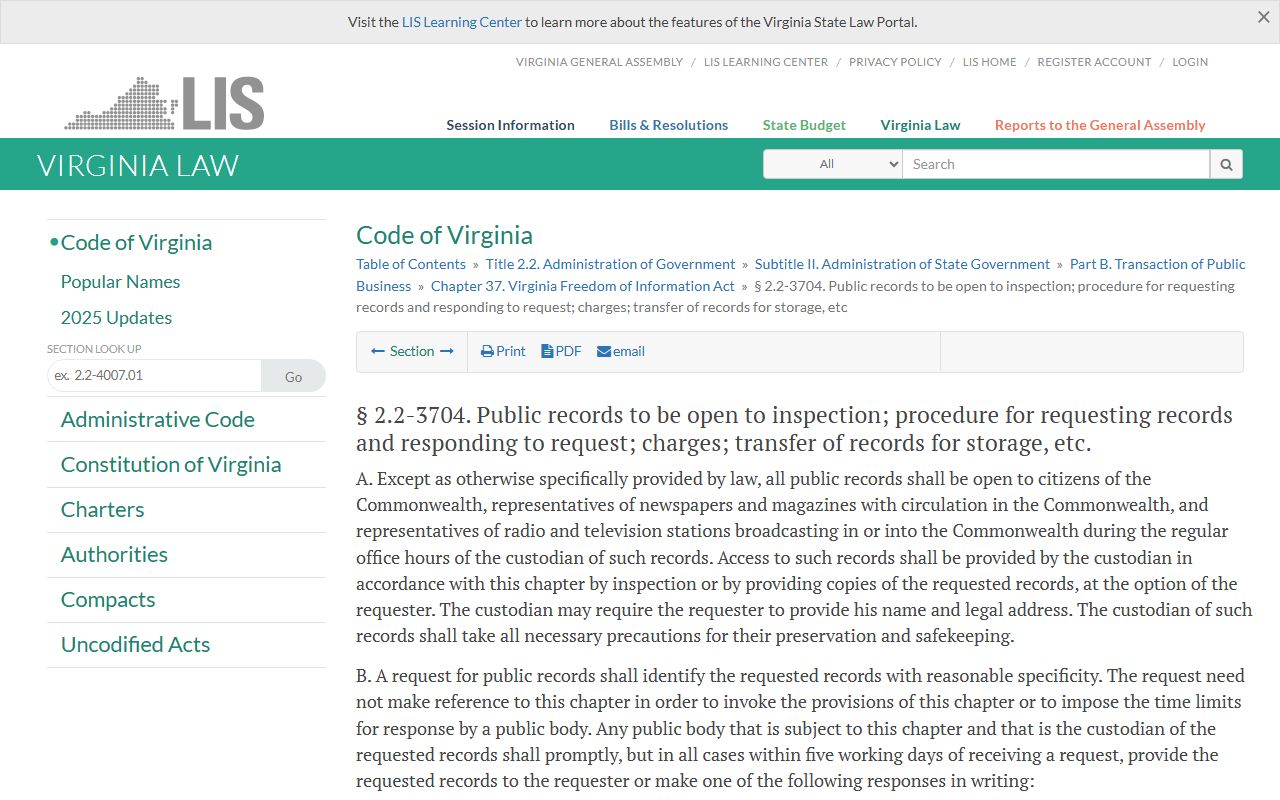
That section is the one to cite when you ask a county agency for budgets, jail policy files, or general administrative records.
You can read the entire FOIA chapter on the Virginia FOIA chapter page. It lists every section, including the rules on fees, format, and exemptions.
How to File a Prince William County Public Records Request
A FOIA request does not need a special form in Virginia. You can ask in writing or by other means. A written request is still the smart move. It creates a clear record of what you asked for and when. The steps below track the process under the act.
- Identify the right public body. County records go to the county; police records go to the police; court files go to the Clerk. Send the request to the office that actually holds the file.
- Put the request in writing. Email or a letter both work. Date it and keep a copy.
- Be specific about the records you want. Name the document, the date range, and the office if you can. A narrow request is faster and cheaper than a broad one.
- Note the response timeline. Under FOIA the public body must respond within five working days. It can take more time in limited cases set by the statute.
- Expect copy and search fees. Ask for a cost estimate up front, and tell the body the most you are willing to pay.
Keep the language plain. You do not have to cite the statute, but naming FOIA can help. If the request touches a court case file, the path is different. Those records follow court rules, not FOIA, and you would work with the Clerk of Circuit Court instead.
Note: A public body may ask you to pay an estimated cost before it starts work when the fee is likely to top a set amount.
Prince William County Public Records the Clerk Maintains
The Clerk of Circuit Court holds a deep set of non-court public records. Virginia folds many roles into one clerk office that other states split among three or four offices. The Clerk is recorder of deeds, issuer of marriage licenses, and keeper of probate and fiduciary files. Most of these records are open to the public.
The list runs long. Deeds, plats, judgments, fictitious names, UCC financing statements, marriage licenses, military discharges, and notary records all sit with the Clerk. So do wills, lists of heirs, and clerk's orders. Land records go online from 1918, and the deed index reaches back to 1732. That depth helps with title work and family history alike.
- Land records - deeds, plats, deeds of trust, and mechanic's liens.
- Probate and fiduciary - wills, estate inventories, accountings, and qualifications.
- Business and finance - fictitious names and UCC financing statements.
- Vital and civil - marriage licenses, judgments, and name changes.
- Other clerk filings - military discharges, notary bonds, and oaths of office.
Some of these files are searchable online, while older ones live only on microfilm or paper at the courthouse. For probate detail, see the Prince William County probate records page. For marriage and divorce files, see the marriage and divorce records page.
Law-Enforcement Records and Prince William County Public Records
Police and Sheriff records follow their own FOIA rule. The key section is Virginia Code § 2.2-3706. It governs the release of criminal incident and investigative records. The section splits records into two groups. Some must be released. Some sit in the discretion of the agency.
Required release covers basic incident data, such as the date, time, and general location of an event. Discretionary release covers active investigative files, which an agency may hold back to protect a case. The statute page below shows how the section draws that line.
The Virginia law site posts the full text of section 2.2-3706 so you can see both tracks.
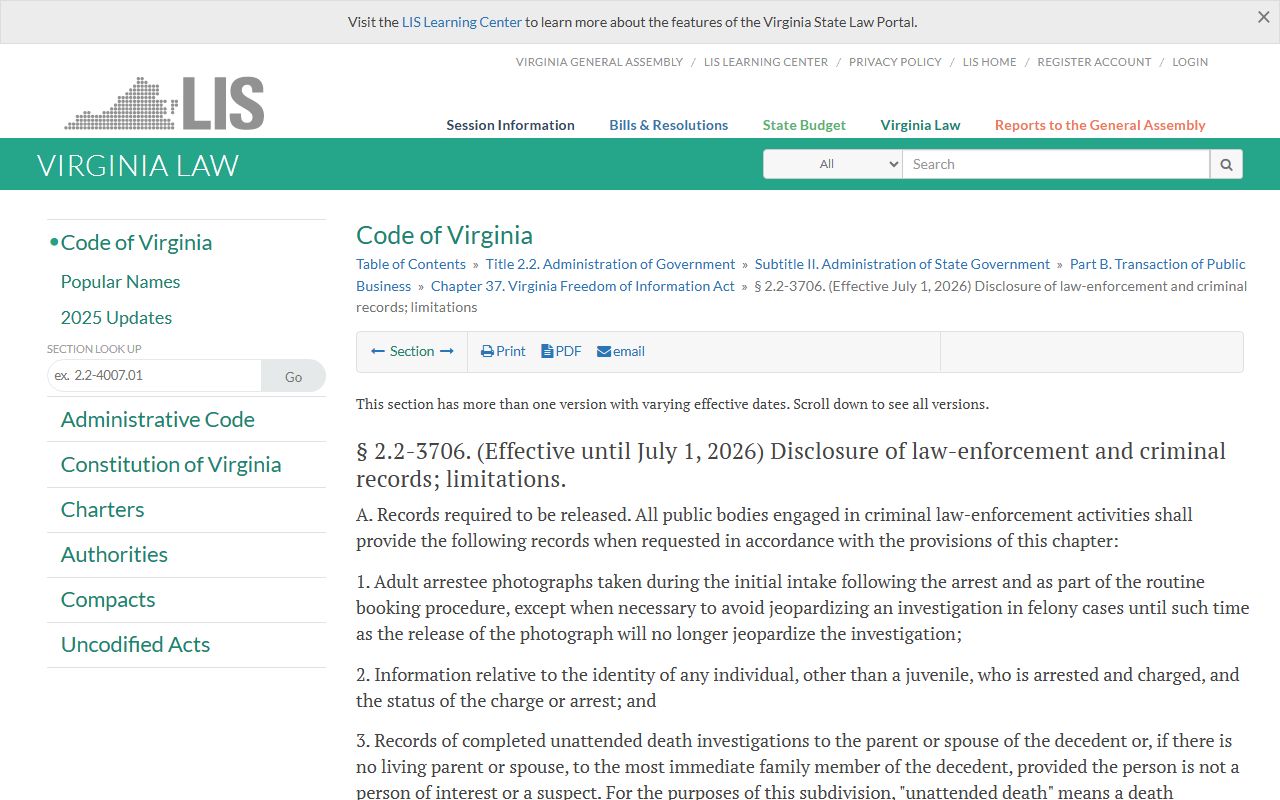
Read it before you ask for arrest or incident files, since the answer often turns on whether a case is still open.
Official criminal history is a separate matter. It does not come through a local FOIA request at all. Criminal history record dissemination is limited to the Virginia State Police under Code of Virginia § 19.2-389. That law sets who may receive a rap sheet and for what use. For arrest and booking data at the local level, see the Prince William County arrest records page.
Court Records Versus Prince William County Public Records
Court case files are public records too, but they do not run through FOIA. They follow court rules and the clerk statutes instead. The governing section for courthouse access is Code of Virginia § 17.1-208. It opens clerk records to inspection unless a statute, rule, or order shuts a file. This is why a FOIA letter is the wrong tool for a case file.
The practical split is simple. Want a county budget? File a FOIA request with the county. Want a divorce decree or a felony judgment? Ask the Clerk under the court rules. The two tracks have different forms, different fees, and different timelines. Mixing them up slows the request down.
Note: Court case copies and FOIA agency records use separate request channels, so send each request to the office that actually holds the file.
For a full walkthrough of the case systems, see the Prince William County court records page. It covers the Circuit Court, the General District Court, and the statewide search tools.
Fees for Prince William County Public Records
Fees depend on the track. FOIA lets a public body charge the actual cost of finding and copying records. That can include staff time at the lowest-paid qualified person's rate. The body must give an estimate when the cost is likely to be high, and you can cap what you agree to pay. Clerk copy fees are set by statute and are simpler to predict.
The table lists the main Clerk copy fees for court and case records. These are the rates the office uses for plain and certified copies.
| Record or Service | Fee |
|---|---|
| Plain copy, per page | $0.50 per page, not to exceed $10 |
| Certified copy | $2 per document |
| Case file, 100 pages or less | $10 |
| Case file, over 100 pages | $25 |
| FOIA agency records | Actual cost of search and copying; estimate given for large requests |
Plan ahead for big files. A long deed chain or a thick case file can run to the higher caps fast. Ask for the page count first when you can. The Clerk contacts you for payment once a request is processed, so include a phone number or an email.
What to Include in a Prince William County Records Request
A clear request gets a faster answer. Whether you write a FOIA letter or fill out a Clerk copy form, the same basic fields show up. The table below maps the fields a typical request needs and what each one is for. Use it as a checklist before you send anything.
| Field | Type | Required | Notes |
|---|---|---|---|
| Requester name | Text | Yes | Virginia FOIA access is for citizens and media; the body may verify residency. |
| Contact information | Email / phone | Yes | The office uses it for cost estimates and to arrange payment. |
| Records described | Text | Yes | Name the document, date range, and office; be as specific as you can. |
| Delivery method | Checkbox | Optional | Mail, pickup, email, or a web link for large files. |
| Certification | Checkbox | Optional | Certified copies cost $2 per document. |
| Fee agreement | Text / amount | Optional | State the most you will pay so work can start without delay. |
Fill in as much as you know. A case number speeds a court copy request. Party names help when the number is unknown. A tight date range cuts the cost on an agency search.
Records Closed to the Public in Prince William County
Not every record is open. Some are closed by statute. Some are sealed by court order. A public records request cannot pry loose a file the law protects. Knowing the closed categories saves time and a wasted fee.
Juvenile case records are restricted. Adoption files are confidential, and only parties may view them. Sealed cases show an index but not the file. Expunged records are pulled from public view. On any record that is released, social security numbers and financial-account numbers are redacted under court rules. Mental-health and guardianship files may hold protected medical detail.
- Juvenile and abuse or neglect files - closed except to parties and authorized agencies.
- Adoption records - confidential by statute.
- Sealed and expunged cases - removed from public access by order.
- Personal identifiers - SSNs and account numbers redacted on release.
- Guardianship and incapacity files - medical detail may be shielded.
When a record is closed, the public body should tell you which exemption applies. If you think a file should be open, you can ask the office to explain the basis. To learn how a closed criminal file can be cleared, see the arrest records page, which covers the expungement steps.
Federal Public Records for the Prince William County Area
Some records are not state or county at all. They are federal. A case heard in a federal court is a federal record, and a local FOIA request will not reach it. The area sits within the federal Fourth Circuit. Appeals from Virginia federal trial courts go to the U.S. Court of Appeals for the Fourth Circuit.
The Fourth Circuit posts opinions, calendars, and clerk information online. Its site is the right starting point for federal appellate matters tied to the region.
Visit the U.S. Court of Appeals for the Fourth Circuit for federal appellate records and court information.
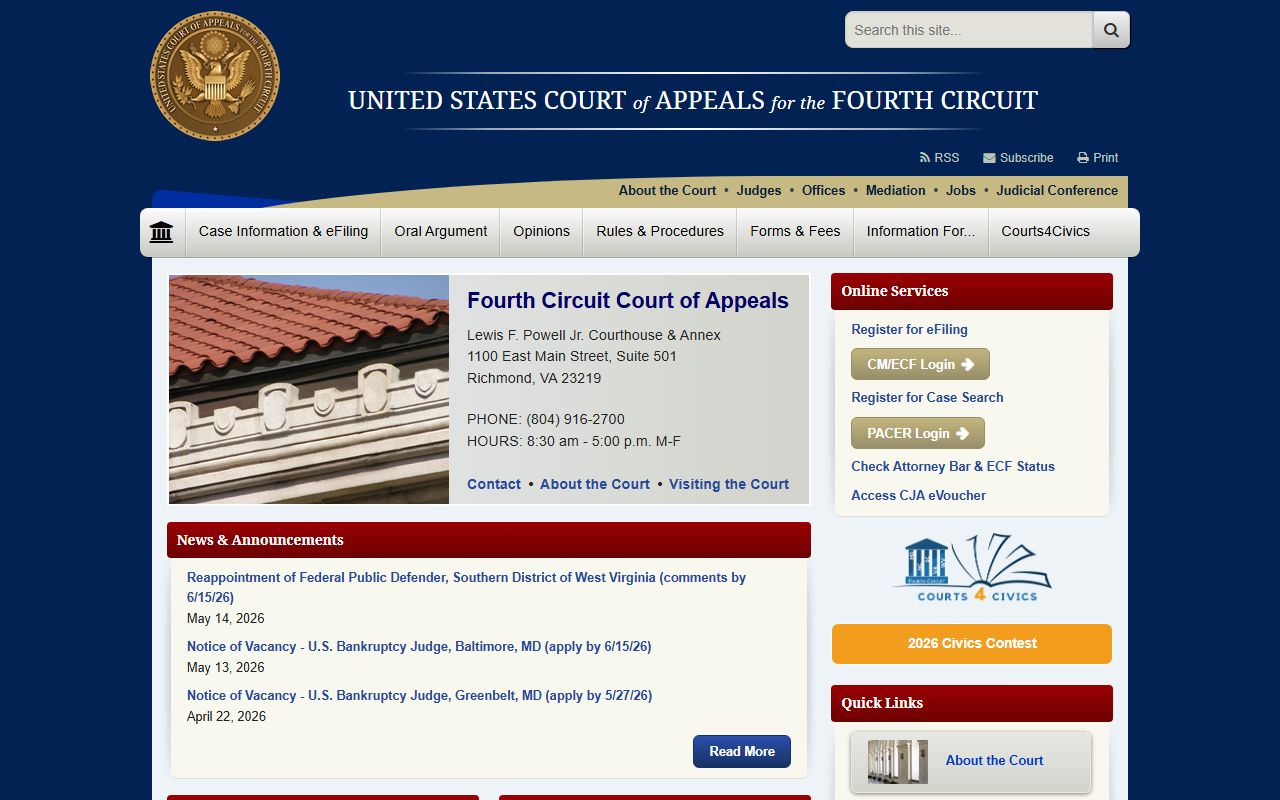
Federal trial-court dockets run through a separate national system, but the Fourth Circuit page links the courts that serve Virginia.
Note: Federal court records and local FOIA records use entirely different systems, so match the request to the level of government that holds the file.