
What Prince William County Court Dockets Show
A docket is a list of cases set for one court day. It shows the case number, the parties, the type of matter, and the time the court means to call it. Some dockets name a judge or a courtroom. Others leave those fields blank until the morning of court. A docket is short by design. It tells you when and where, not the whole story of a case.
The full case file is a different thing. It holds the complaint, the motions, the orders, the service returns, and the final disposition. A docket points you to a case. The file tells you what happened in it. If you want the outcome, the pleadings, or a certified copy, you go to the case file through the Clerk, not the docket. The two work together. One is the calendar. The other is the record.
Most dockets group cases by division. Criminal cases sit on one list. Civil cases sit on another. The Circuit Court, the General District Court, and the JDR court keep separate dockets because each court hears its own matters. To read a docket well, start with the right court and the right division.
Note: A docket gives the time and place of a hearing, while the case file holds the papers and the outcome, so check both when you research a case.
How to Find Prince William County Court Dockets
The Circuit Court posts its next civil and criminal dockets online. You can pull up the upcoming lists without a trip to the courthouse. These dockets cover cases set for term day and other scheduled court events. They update as the court date nears, so a fresh check is wise the day before.
The county's Circuit Court dockets page links the next civil and criminal dockets in one place.
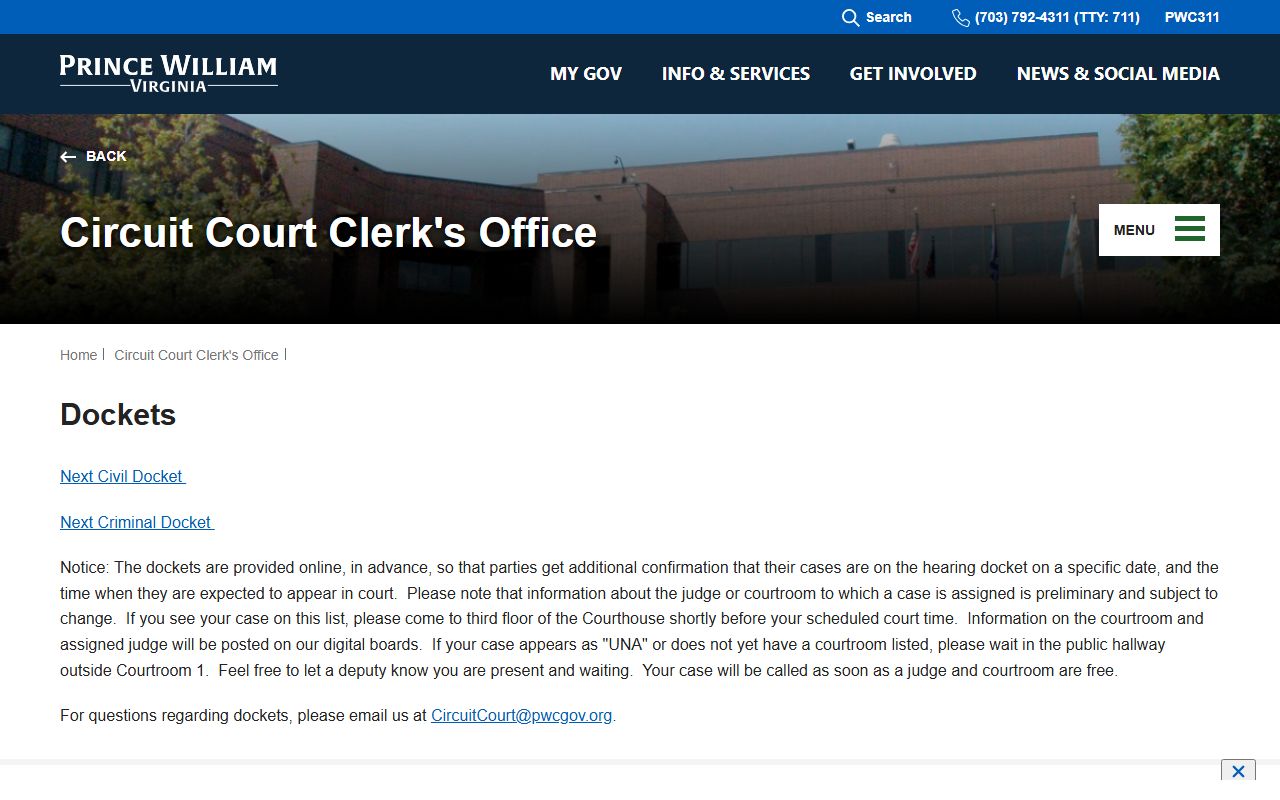
The page lists the docket files by division so you can open the one that fits your case.
The docket PDFs carry a warning. Judge and courtroom assignments on them are preliminary. They can change before court opens. The digital docket boards inside the courthouse control on the day of the hearing. So treat the PDF as a guide, then confirm against the boards when you arrive. This matters most when a case shows no courtroom or a placeholder code.
For a hearing date in a misdemeanor, traffic, or small civil claim, the General District Court keeps its own case search instead of a posted PDF docket. You search that system by hearing date to see what is set. The same goes for JDR family and juvenile matters, though many of those are closed to the public.
How to Find a Hearing Date in Prince William County
You do not always need the posted docket to learn a court date. Both the Circuit and General District case systems let you search by hearing date. Pick the court, pick the division, then enter the date. The result shows the cases set and, where available, the courtroom. This is the fastest way to confirm when a single case is called.
- Open the Circuit Court Case Information system and select Prince William County Circuit, then click Begin.
- Choose the Criminal or Civil division for the case you want to track.
- Click the Hearing Date search method and set the date on the calendar.
- Read the result list to see the cases set and the courtroom shown for that date.
- For traffic, misdemeanor, or small civil claims, search by hearing date in the General District Court Case Information system instead.
The Circuit system has no statewide option. You search one court at a time, so always pick Prince William first. The portal also asks you not to use the browser back button and not to bookmark inner pages. If a session sits idle too long, it times out and you start over.
Case numbers help narrow a search. Circuit numbers begin with C, General District numbers begin with G, and JDR numbers begin with J. When you search the Circuit system by case number, the county tells you to type CR or CL in upper case. The Prince William County court records page covers the full case search step by step.
Term Days on the Prince William County Court Calendar
The Circuit Court runs on a term-day calendar. Term days are set court days when groups of cases are heard. The grand jury and the criminal and civil term days follow a fixed monthly pattern. Knowing the pattern helps you read a docket and plan a filing. The schedule sits on the court calendar page.
The county's Circuit Court calendar page lists the term days and the grand jury schedule.
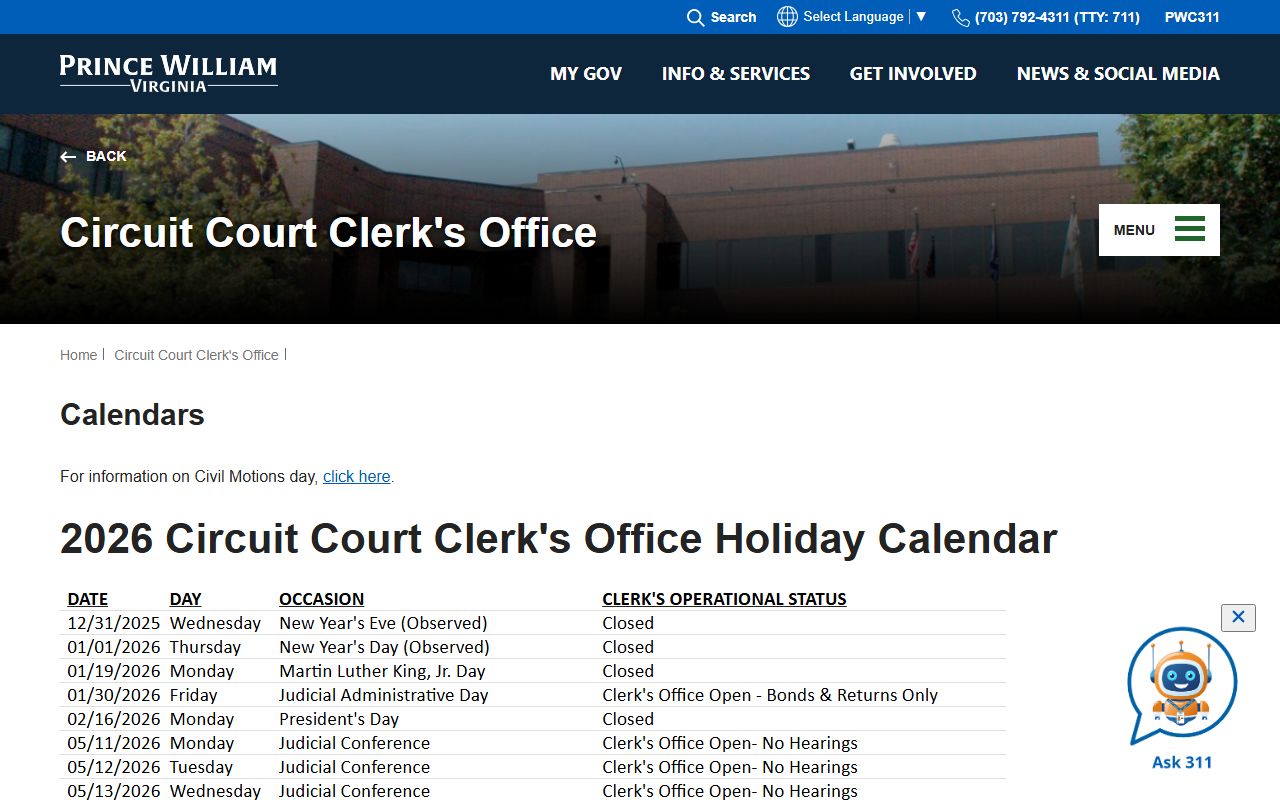
The calendar shows how the grand jury, criminal term, and civil term line up across the month.
The grand jury meets the first Monday of each month at 8:30 a.m. If that Monday is a holiday, it moves to the next business day. Criminal Term Day follows the day after the grand jury meets and starts at 10:00 a.m. Civil Term Day falls on the first Tuesday after the first Monday and starts at 2:00 p.m. For a civil case to be heard on term day, it must be noticed by the preceding Wednesday at 5:00 p.m., unless the calendar says otherwise.
| Event | When | Time |
|---|---|---|
| Grand jury | First Monday of the month | 8:30 a.m. |
| Criminal Term Day | Day after the grand jury meets | 10:00 a.m. |
| Civil Term Day | First Tuesday after the first Monday | 2:00 p.m. |
| Civil notice cutoff | Preceding Wednesday | 5:00 p.m. |
Term days move when a holiday lands on the set day. Always check the posted calendar before you count on a date. A missed notice cutoff can push a civil matter to the next term.
When a Prince William County Docket Shows UNA
Sometimes a docket lists no courtroom. Sometimes it shows the code UNA, which means a courtroom is not yet assigned. This is common in the morning before the court sorts its day. It does not mean your case was dropped. It means the judge and room are still being set. The digital boards in the courthouse fill in the gap once court opens.
The court tells you what to do in that case. Wait in the public hallway outside Courtroom 1. Let a deputy know you are present. Your case will be called once a judge and a courtroom are free. So show up at the set time, find Courtroom 1, and check in with the deputy. Do not leave because the PDF showed no room.
Important: Docket PDFs show preliminary judge and courtroom assignments. The digital docket boards inside the courthouse control on the day of the hearing, so confirm your room against the boards, not the printout.
The two tools work as a pair. The PDF gives you a heads-up the day before. The boards give you the final word on the morning of court. When they disagree, trust the boards. And when in doubt, ask the deputy in the hallway.
Ore Tenus Divorce Hearings in Prince William County
Divorce cases have their own slot on the Circuit Court calendar. Ore tenus hearings are short, in-person divorce hearings where a party gives testimony before the judge. Prince William holds these on the first and third Thursdays of the month at 9:00 a.m. The timing is fixed, so a divorce docket for those days fills with these matters.
These hearings sit in the Circuit Court because that is where divorce is filed and heard in Virginia. The local schedule says a case may be set for an ore tenus hearing roughly two to three months after the first filing, as long as the papers are accurate and complete. Errors or missing documents can push the date back.
To track a divorce hearing, search the Circuit system by case number or by hearing date. Set the date to a first or third Thursday to see the ore tenus list. For more on divorce filing and copies, see the Prince William County marriage and divorce records page. The Clerk of Circuit Court page covers certified copies and request methods.
Note: Ore tenus divorce hearings fall on the first and third Thursdays at 9:00 a.m., so search those dates in the Circuit system to find a divorce docket.
Reading a Prince William County Court Docket Entry
A docket entry packs a lot into a few fields. Each one tells you something about when and where a case is heard. The table breaks down the common fields and what each one shows. Use it to read a Circuit or General District docket with less guesswork.
| Field | What It Shows |
|---|---|
| Case Number | Court and case ID; C for Circuit, G for District, J for JDR. |
| Parties | Plaintiff or petitioner and defendant or respondent. |
| Hearing Date | The day the case is set to be called. |
| Time | The scheduled start time for that division or term. |
| Courtroom | Room assignment; may show UNA or stay blank until court opens. |
The courtroom field is the one to watch. A blank room or a UNA code is not final. The boards settle it on the day. Hearing types also matter. A status call is short. A trial can run long. So read the matter type to gauge how long you may wait.
A few docket terms come up often:
- Docket
- A schedule or chronological list of case events set for a court day.
- Hearing
- A court appearance for argument, evidence, status, or disposition.
- Continuance
- A postponement that moves a case to a later court date.
- Term Day
- A set monthly court day when grouped civil or criminal matters are heard.
Which Prince William County Court Posts Your Docket
The county runs three trial courts in one complex, and each keeps its own docket. Prince William sits in Virginia's 31st Judicial Circuit and 31st Judicial District. The Circuit Court hears felonies, major civil suits, divorce, and chancery. The General District Court hears misdemeanors, traffic, and civil claims up to $25,000. The JDR court hears juvenile and family matters, many of them closed.
The court level sets where you look for a docket. Circuit dockets are posted as civil and criminal PDFs and searchable by hearing date. General District hearings show up in that court's case search. JDR dockets are limited because the cases are often confidential by statute. So match the case number letter to the right court first.
The Clerk of Circuit Court cannot help with General District or JDR matters. Each court has its own clerk and its own phone lines. The General District traffic and criminal division answers at (703) 792-6141, and the civil division answers at (703) 792-6149. For felony and major civil cases, the Prince William Circuit Court page covers the court structure. The arrest records page covers booking and criminal case basics, and the FAQ page answers common docket questions.