
How Prince William County Probate Records Work
Probate means proving a will. The will is admitted to record in the Clerk's Office, and from that point it is a public file. There is no probate judge in a separate building here. The Clerk of Circuit Court acts as the probate authority for these matters. The Probate Office records the will, then qualifies an executor or administrator who can act for the estate.
The office also schedules guardianship and conservatorship appointments. Those come from court orders that name someone to look after an incapacitated adult. So the same office that proves a will may also handle the file for a person who can no longer manage on their own.
Probate must be done where the person lived. Prince William handles estates for people who resided in Prince William County, the City of Manassas, or the City of Manassas Park. If a person lived in a nursing or convalescent home, the law presumes the residence stays the same as it was before they became a patient, unless someone shows otherwise. Pick the right court first, or the file will not be here.
The county's probate page lays out who qualifies and how a will is proved.
You can read the probate and qualify wills page for the full local process.
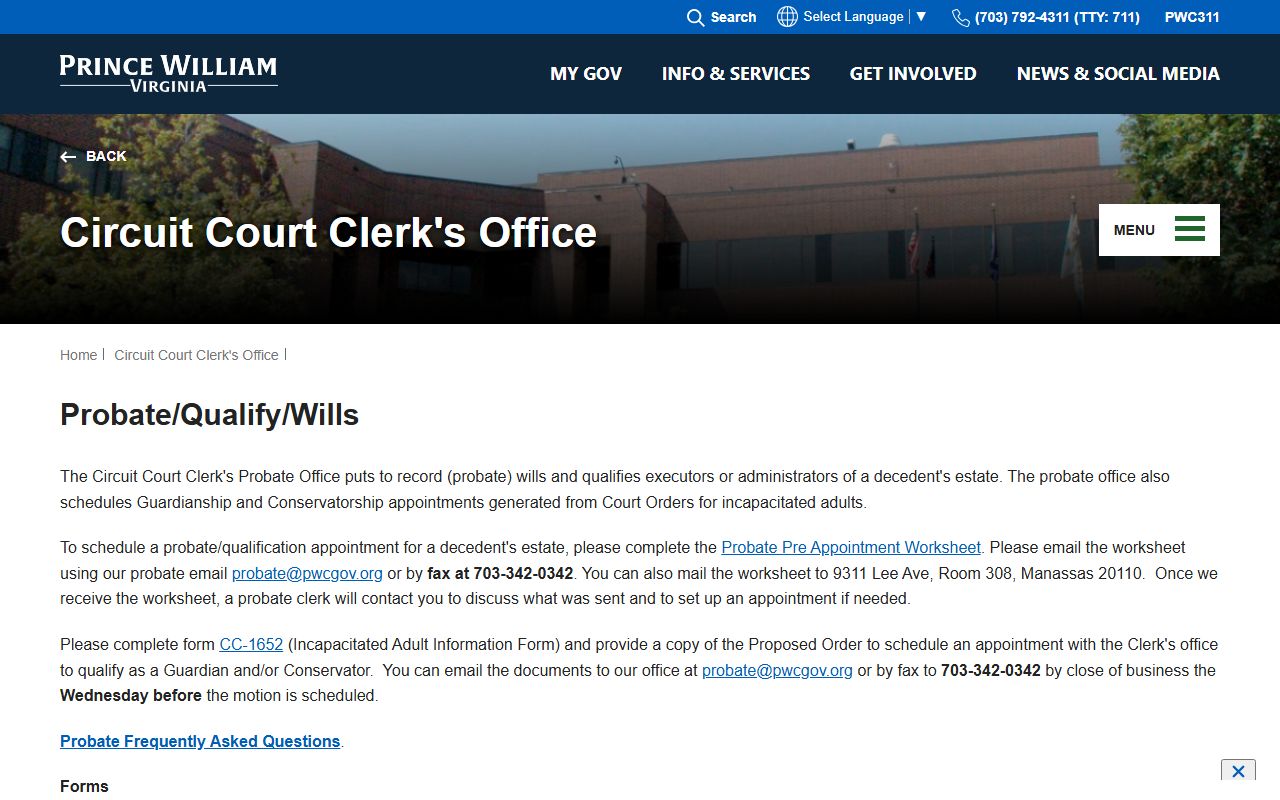
It explains the worksheet, the appointment, and what the Clerk needs before an executor can act.
How to Start a Prince William County Estate File
The first step is a worksheet. You complete the Probate Pre Appointment Worksheet, then send it to the office. A probate clerk reads it, then reaches out to talk about what you sent and to set an appointment if one is needed. You do not just walk in and file. The contact comes first.
- Fill out the Probate Pre Appointment Worksheet with the details of the person who died and the estate.
- Send the worksheet by email to probate@pwcgov.org, by fax to 703-342-0342, or by mail to 9311 Lee Ave, Room 308, Manassas, VA 20110.
- Wait for a probate clerk to contact you to review the file and set a time.
- Bring the will, the death certificate, and any other papers the clerk asks for to the appointment.
- Qualify as executor or administrator, then pay the fees due that day.
Guardian and conservator cases follow a separate track. For those, you complete Form CC-1652, the Incapacitated Adult Information Form. You also give the office a copy of the proposed order. Both must reach the clerk by email or fax by close of business the Wednesday before the motion. Miss that cutoff and the matter may not be ready in time.
Note: There is no fixed deadline to probate a will in Virginia, but the office recommends taking the first steps within thirty days after the death.
Key Terms in Prince William County Probate Records
Probate files use words that do not come up in daily life. A few short definitions help you read what an estate record says. The same terms show up on the worksheet and in the orders the Clerk records.
- Testator
- The person who made the will. A will speaks for the testator after death.
- Executor
- The person named in a will to settle the estate and carry out its terms.
- Administrator / Intestate
- When there is no will, the estate is intestate, and the court qualifies an administrator to settle it.
- Guardianship
- A court role that gives someone authority over the personal care of an incapacitated adult.
- Conservatorship
- A court role that gives someone authority over the money and property of an incapacitated adult.
An executor and an administrator do much the same work. The difference is the will. With a will, the named executor steps up. Without one, the court picks an administrator. Both are called the personal representative of the estate.
Figuring Estate Value for Prince William County Probate
Estate value drives the fees, so the office is clear about how to count it. You add up the property that was in the name of the person who died, and only that name, as of the date of death. You do not subtract debts. You do not subtract a mortgage. The gross value is what counts for the qualification fee.
Some assets stay out of the count. These pass outside probate and do not belong in the estate total:
- Joint survivorship assets that pass to the other owner.
- Beneficiary-designated assets, such as life insurance with a named person.
- Assets held in a trust.
- Payable-on-death accounts that name a recipient.
Small estates often need no formal administration at all. When the estate is $50,000 or less, the office says full administration is frequently not needed. There is also the Small Estate Act path. Its affidavit may apply to personal property that does not top $50,000, sixty days after death, when no personal representative has qualified. A death certificate is required for that route. So a modest estate may settle without a long court process.
Prince William County Probate Records Fee Schedule
Fees depend on the estate value and on how many pages get recorded. There is a state probate tax plus a qualification fee, and the Clerk charges to record and copy documents. The table lists the main charges. Bring a way to pay at the appointment.
| Item | Fee |
|---|---|
| State probate tax | One tenth of one percent, or $1 per $1,000, on real and personal estate in the decedent's name only |
| Qualification, estate $5,000 or less | $0 |
| Qualification, estate not over $50,000 | $20 |
| Qualification, estate not over $100,000 | $25 |
| Qualification, estate over $100,000 | $30 |
| Recording, 10 or fewer pages | $18 |
| Recording, 11 to 30 pages | $32 |
| Recording, 31 or more pages | $52 |
| Updated letters of qualification | $2 |
| Copies | $0.50 per page |
| Real estate transfer fee | $1 per transfer when real estate is involved |
The state probate tax is small. It works out to one dollar for every thousand dollars of estate value. The qualification fee is a flat charge that rises with the size of the estate. Recording fees turn on the page count of what gets filed. Copy fees are the same fifty cents per page that apply to other Clerk records.
Note: The qualification fee is $0 when the estate is $5,000 or less, so very small estates may pay only the state probate tax and recording cost.
Prince William County Probate Office Contact
The Probate Office sits in Room 308 of the Judicial Center on Lee Avenue in Manassas. You send the worksheet there first. The Clerk of Circuit Court runs the office, and the broader Clerk's Office handles wills, land records, and the rest of the estate paperwork. Both contacts are listed below.
Probate Office
9311 Lee Avenue, Room 308
Manassas, VA 20110
Fax (703) 342-0342
Email: probate@pwcgov.org
Clerk of Circuit Court
9311 Lee Avenue, Third Floor
Manassas, VA 20110
(703) 792-6015
Mon-Fri 8:30 a.m. to 5:00 p.m.
Send the worksheet by one of the three methods first. Then wait for the call or email. A clerk will set the appointment and tell you what to bring. The Clerk of Circuit Court page has more on copy methods and fees for estate and land files.
Appealing a Prince William County Probate Order
A clerk order can be challenged. When the clerk admits a will to probate, any interested person may appeal that order to a judge. The window is six months from the date of the clerk's order. After that, the chance to appeal is gone.
An interested person usually means an heir, a named beneficiary, or someone else with a stake in the estate. The appeal moves the matter from the clerk to a Circuit Court judge. It does not mean the will is wrong. It means a court will take a second look at whether it was properly admitted.
If you think a will should not have been proved, act fast. Six months passes quickly while an estate is being settled. The Clerk can tell you the date of the order, which is when the clock starts.
Confidential Records Tied to Probate
Most probate files are open. Wills become public once admitted to record, and estate accounts are filed with the office. But not every clerk-handled matter is fully open. Guardianship and conservatorship files can hold medical or incapacity detail that a statute or a court order keeps from public view.
Some matters near the probate office touch other restricted files. Records tied to minors or to certain protected proceedings are limited by law.
One example is Virginia's juvenile-record rule, posted by the state code site.
The statute at Virginia Code § 16.1-305 sets the confidentiality of juvenile records, a related restriction the Clerk may apply to certain files.
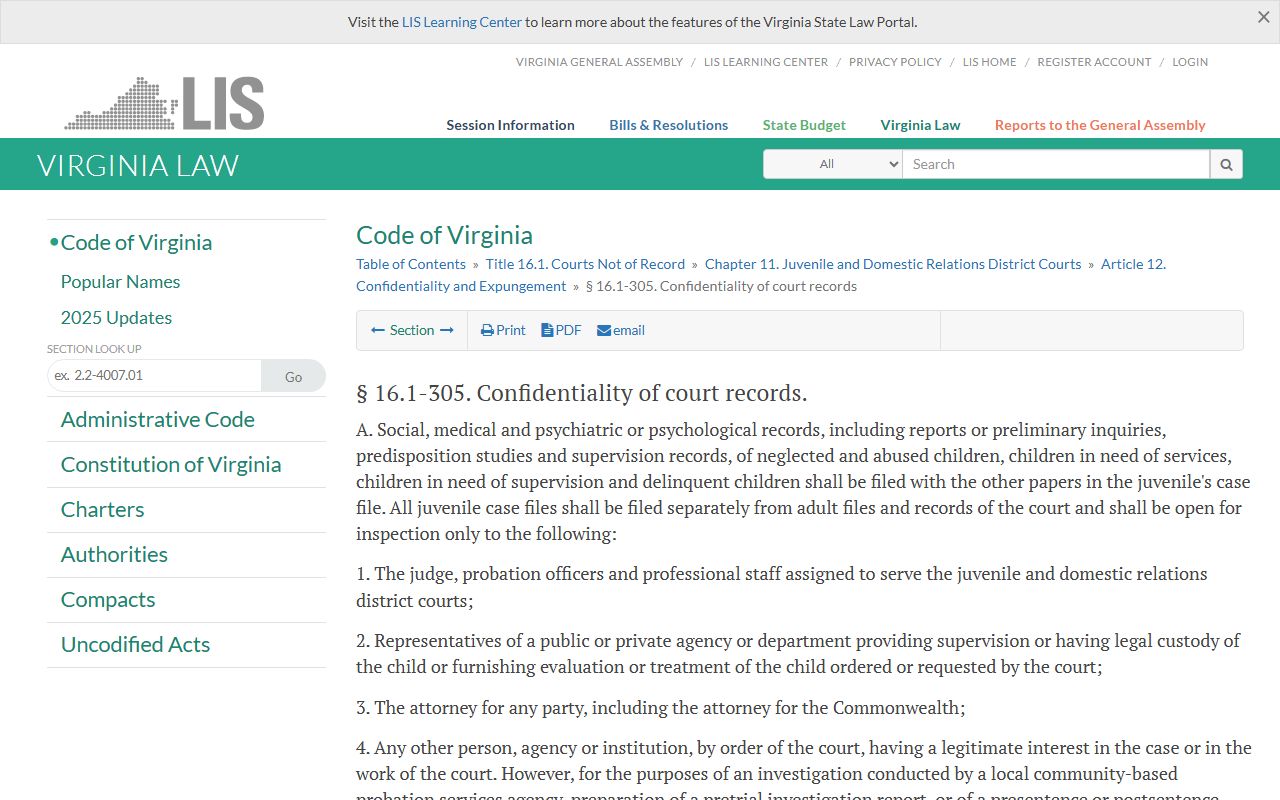
It shows how some court-handled matters are shielded by statute, even when most estate files stay open.
Note: Guardianship and incapacity files may hold protected detail, so call the Clerk before a trip if you are unsure whether a file is open.
Common Prince William County Probate Questions
A few questions come up again and again at the office. The probate FAQ page covers the basics that most families ask after a death. The answers below pull from that page and the local fee schedule.
You can read the full probate FAQ page for the office's own answers.
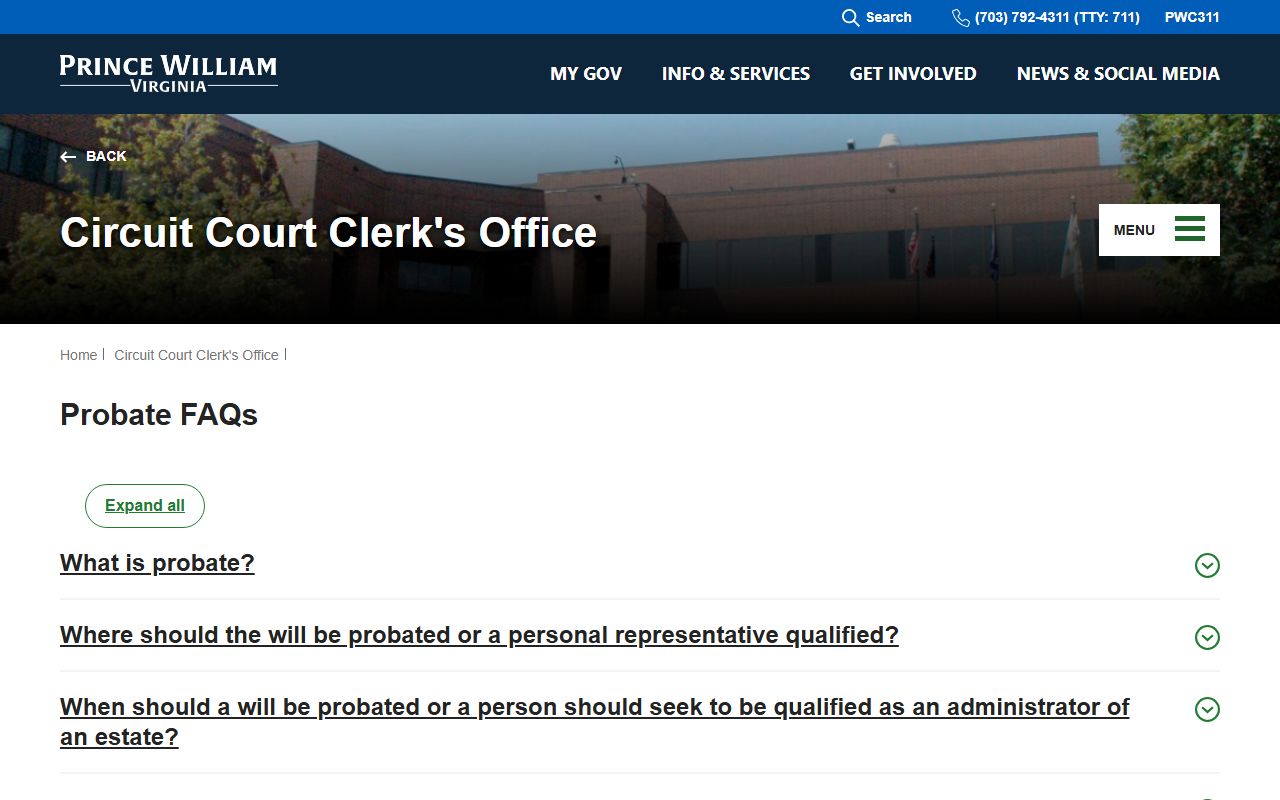
It walks through residence rules, estate value, and when formal administration is needed.
What is probate? Probate is the act of proving a will and admitting it to record in the Clerk's Office. Estate administration is a separate step that may follow, where the office appoints an executor or administrator to settle the estate.
Where do I probate a will? File in the Circuit Court Clerk's Office of the city or county where the person lived. Prince William handles people who resided in Prince William County, Manassas, or Manassas Park.
Do small estates need administration? Often, no. The office says full administration is frequently not needed when an estate is $50,000 or less, and the Small Estate Act affidavit may cover personal property up to that limit after sixty days.